
Does eating in the evening make you gain weight? What the research actually says

Anatol Maidanschi, nutritionist
4 min read
There is no magic hour after which every food automatically turns into fat. Still, when we eat can matter.
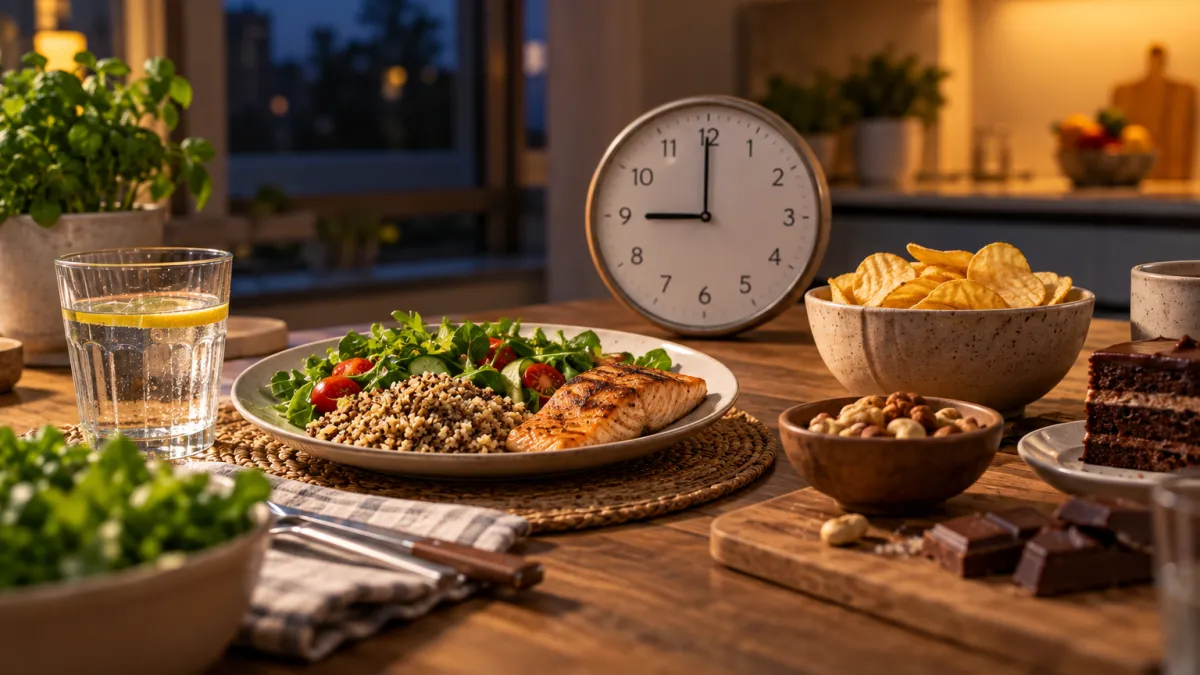
“Everything you eat after 6 pm gets stored as fat.”
You’ve probably heard this many times. But things are more nuanced.
There is no magic hour after which every food automatically turns into fat. Still, when we eat can matter, especially when meals are constantly pushed into the late evening and night.
A meta-analysis published in 2026 in Nutrition Reviews looked at the available studies on late eating and obesity. In adults, eating late was associated with a higher risk of obesity. The authors point out, however, that most of the data come from observational studies, so we can’t say that the late hour alone causes the extra kilos.
So why can the time you eat matter?
Our body runs on a circadian rhythm — a kind of biological clock that influences sleep, hormones, appetite and metabolism.
In a controlled study published in Cell Metabolism, the same participants ate the same foods and the same number of calories, but at different times.
When they ate later, the researchers observed more hunger, changes in the hormones that regulate appetite and lower energy expenditure while awake.
Another controlled study showed that moving meals about four hours later changed the way the body used fats and carbohydrates, even though sleep duration and the eating window were kept similar.
This doesn’t mean a late dinner will automatically make you gain weight.
It means that eating late, again and again, can create conditions that are less favourable for weight control.
The problem isn’t just the time
In my experience, the problem with late meals is very often also what happens around them.
A person gets home tired and very hungry.
They start with dinner.
Then they taste something else.
Something sweet appears.
Maybe another glass of juice or a snack in front of the TV.
And without realising it, the evening meal becomes one of the most calorie-rich parts of the day.
That’s why, when I recommend finishing eating earlier, it’s not because at a certain hour the body flips a switch and starts automatically turning food into fat.
I do it for structure.
A clear period when you eat and one when you no longer eat can help a person cut unnecessary snacks, control their appetite better and break the habit of eating all evening.
What about intermittent fasting?
Here, too, we need to avoid extremes.
Restricting the window in which we eat can be a useful method for some people, but it isn’t magic.
A meta-analysis published in 2026, which looked at time-restricted eating combined with exercise, found modest reductions in body weight and fat mass, with no significant change in waist circumference. The researchers note, however, that larger and longer studies are needed to establish the best approaches.
For me, more important than the name of the diet is the question:
Can the person stick to this way of eating in three months, six months or a year?
If the answer is no, we probably haven’t built a good solution.
What I recommend
Instead of obsessively asking yourself:
“Am I allowed to eat at 7 pm?”
ask yourself:
- How much have I eaten today?
- Why am I eating now — because I’m hungry or out of habit?
- How long has it been since my last meal?
- Am I going to bed soon?
- Does this meal help me reach my goal, or is it yet another snack I hadn’t even planned?
Sometimes this check tells you more than the clock.
I prefer a clear eating schedule, well-defined meals and as little “grazing” between them as possible.
For many people, moving the last meal earlier is simply a very good way to build this discipline.
What I want you to remember
No, food doesn’t automatically turn into fat after 6 pm.
But the idea that “the time doesn’t matter at all” isn’t supported by all the available data either.
Current research suggests that very late meals can affect appetite and metabolism and are associated with a higher risk of obesity in adults.
That’s why, for me, the rule is simple:
eat enough and eat well during the day, set your meal times and try not to turn the evening into one long stretch of eating.
— Anatol Maidanschi, nutritionist
Questions for you
What time do you usually have your last meal?
And what’s harder for you in the evening: hunger or the urge to taste something else?
Send me a message — I read and reply personally.
What should we look at in the next article?
Thank you for voting!
Sources
- Park Y, Cho H, Myung SK. Late Eating and Obesity: A Meta-Analysis of Observational Studies. Nutrition Reviews, 2026. doi:10.1093/nutrit/nuag087
- Vujović N, Piron MJ, Qian J, et al. Late isocaloric eating increases hunger, decreases energy expenditure, and modifies metabolic pathways in adults with overweight and obesity. Cell Metabolism, 2022. doi:10.1016/j.cmet.2022.09.007
- Allison KC, Hopkins CM, Ruggieri M, et al. Prolonged, Controlled Daytime versus Delayed Eating Impacts Weight and Metabolism. Current Biology, 2021. doi:10.1016/j.cub.2020.10.092
- Liu H, Hu G, Ma X. Effects of combining exercise with a 16:8 time-restricted eating protocol on body composition and glucose-lipid metabolism in adults: a systematic review and meta-analysis. Frontiers in Nutrition, 2026. doi:10.3389/fnut.2026.1816555
This article is for educational purposes and does not replace individual medical or nutritional advice.